Resurrection Sunday Service
April 5, 2026
Die Stil Krag van God se Koninkryk
July 26, 2026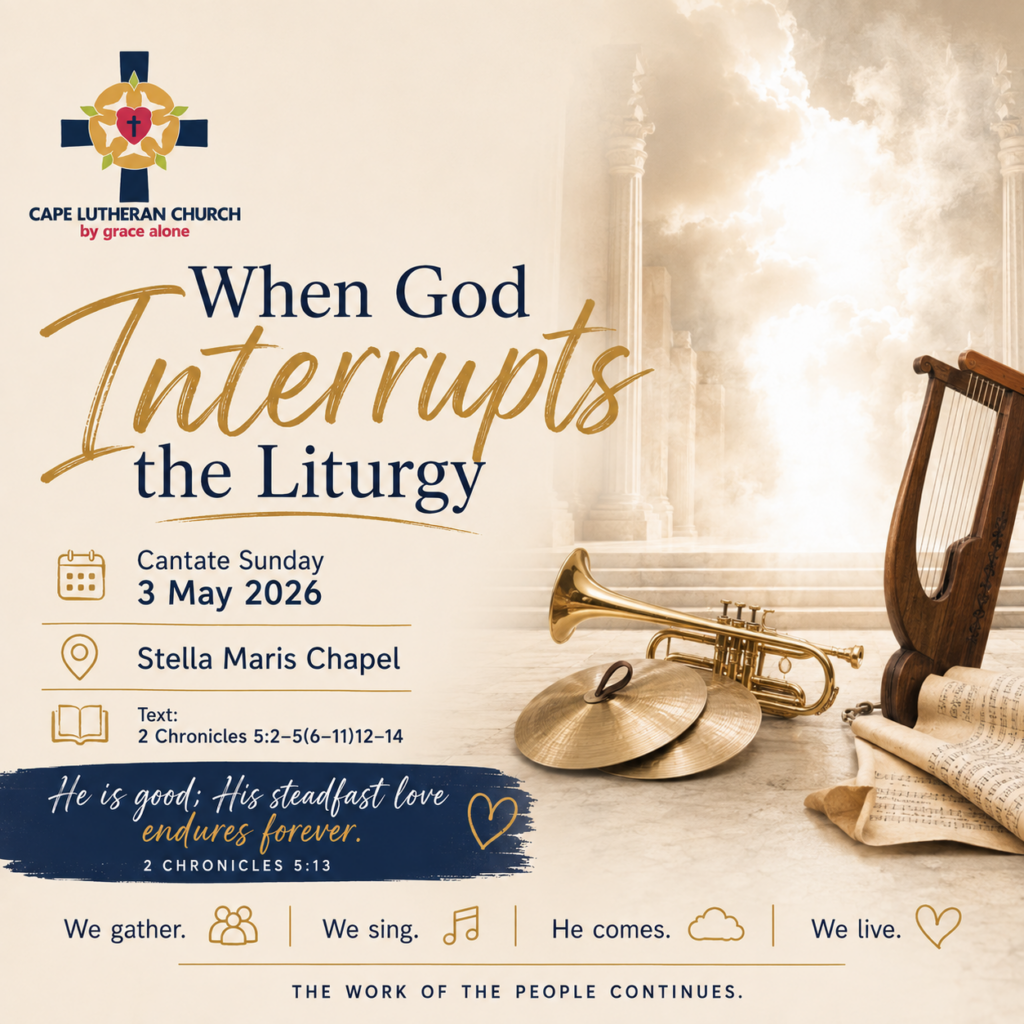
Cantate Sunday – 3 May 2026 Stella Maris Chapel
Text: 2 Chronicles 5:2–5(6–11)12–14
Introduction
You know that moment before worship begins: the hymns are marked, the prayers prepared, the sermon written. Everything is in place. That’s what liturgy does — it gives shape to our worship. The Greek word means “the work of the people.”
But today’s text tells of a moment when everything was perfectly arranged… and then God interrupted.
The Crescendo of Worship
The author of 2 Chronicles 5 writes like a composer building a symphony:
The Gathering — Solomon calls everyone together.
The Carrying — the priests lift the Ark, history moving into the present.
The Music — 120 trumpets, cymbals, harps, and a massive choir singing: “For He is good; His steadfast love endures forever.”
It is flawless worship. Every note hit, every ritual followed. And then — the unexpected. A cloud fills the temple. The glory of the Lord arrives. The priests cannot continue.
The liturgy stops. Not because something failed, but because the One they were singing about actually showed up.
Imagine being in an opera house, listening to Beethoven’s Ninth Symphony. The choir is magnificent, the conductor a maestro. And suddenly Beethoven himself walks onto the stage. The music ceases. All eyes turn to him. That is what happened in the temple: the Composer entered.
The Honest Question
This is Cantate Sunday — the Sunday of singing. But what is our expectation?
Sometimes we use liturgy to manage God rather than meet Him. We like the “work of the people” because it keeps us busy, gives us control. But the miracle of worship is not that we did everything right. The miracle is that God comes to us.
Even the Ark’s poles sticking out remind us: God is present, but He cannot be contained by a building, a denomination, or a tenminute sermon.
From Temple to Life
In Acts 2, the Spirit does not fill a stone building — He fills people. If liturgy is the work of the people, it does not end with “Amen.” Your life becomes the temple.
God still interrupts:
He interrupts your plans with His call.
He interrupts your bitterness with forgiveness.
He interrupts your comfort with a neighbor in need.
He interrupts your ordinary routines with extraordinary grace.
The work of the people continues in kindness, patience, mercy. Worship does not end at the chapel door — it spills into kitchens, hospital rooms, conversations, and ordinary afternoons.
The Cloud of Glory
Notice what happened in the temple: the priests could not continue their service. The liturgy was interrupted, but not destroyed. It had fulfilled its purpose — it led them to God’s presence.
That is our deepest hope: not perfect hymns, flawless liturgy, or polished sermons, but that somewhere between the first note and the final blessing, the Composer quietly walks onto the stage.
In a song, a prayer, or even an unplanned silence, we realize: God is here. And when that happens, we stop managing, stop worrying, and simply stand — like the priests — aware of His presence.
Closing
Cantate Sunday reminds us: we sing not to impress God, not to perform perfectly, but to open our hearts. And if the cloud should fill the room — if the Spirit moves and we fall silent in awe — then the liturgy has done exactly what it was meant to do. It has led us to Him.
And when the service ends, the liturgy continues. The Spirit walks with us into daily life. Suddenly, our ordinary lives become worship. The kindness we show, the mercy we give, the hope we carry — all of it becomes a living liturgy.
And now may the peace of God, which surpasses all understanding, guard your hearts and minds in Christ Jesus. Amen.