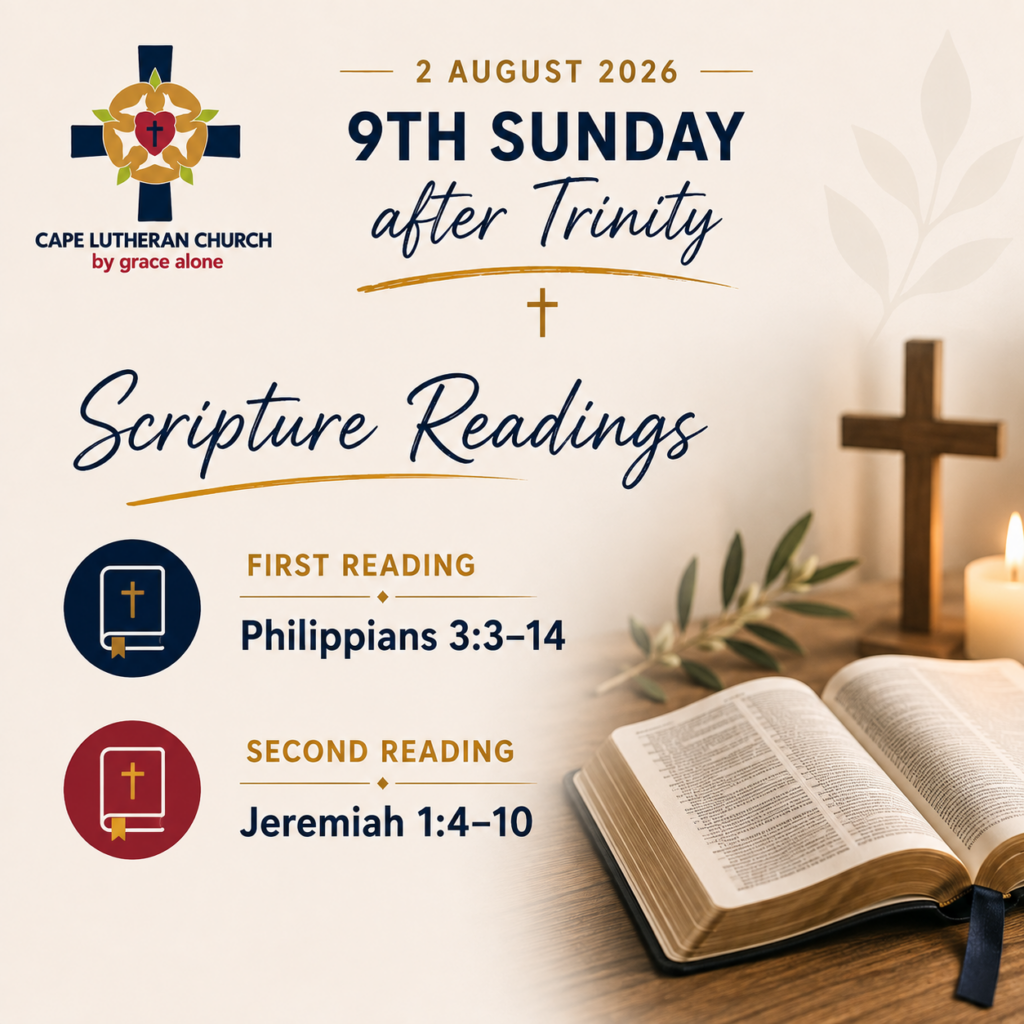
9th Sunday after Trinity
August 2, 2026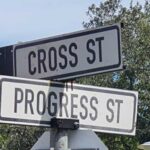
Cross street Building photos for September
September 9, 2026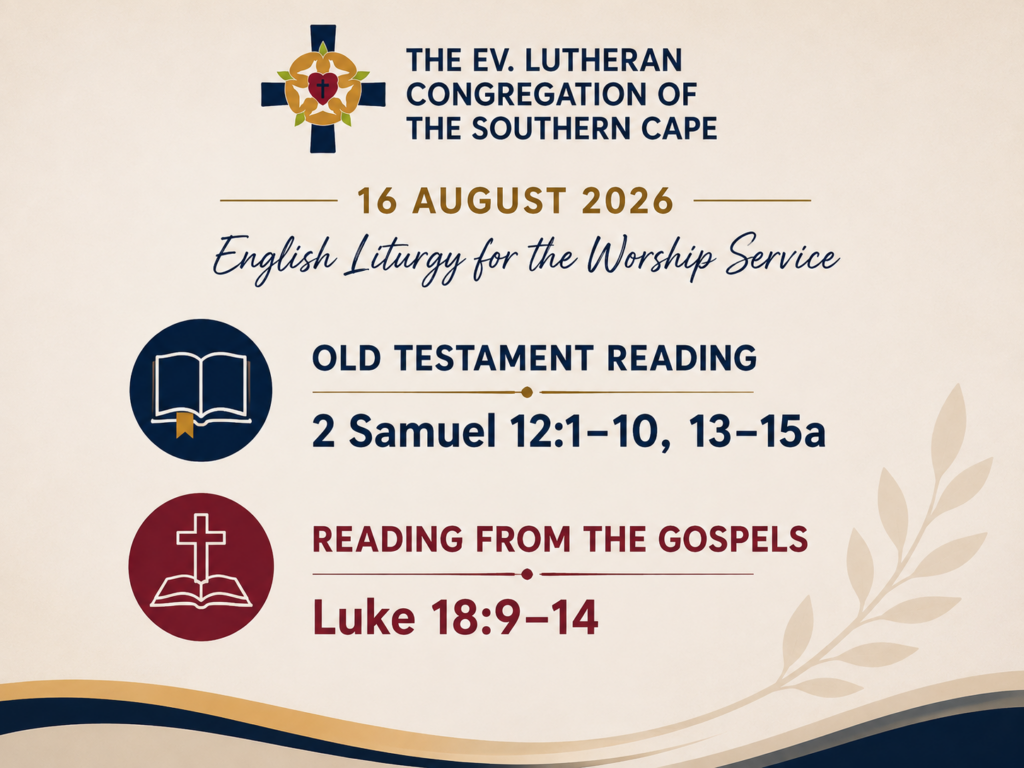
THE EV. LUTHERAN CONGREGATION OF THE SOUTHERN CAPE
English Liturgy for the Worship Service
Text for the Week – 1 Peter 5:5b
“God opposes the proud but shows favour to the humble.”
“God weerstaan die hoogmoediges, maar aan die nederiges gee Hy genade.”
- Announcements
- Psalm 145
A psalm of praise. Of David.
I will exalt you, my God the King;
I will praise your name for ever and ever.
Great is the Lord and most worthy of praise;
his greatness no one can fathom.
One generation commends your works to another;
they tell of your mighty acts.
The Lord is gracious and compassionate,
slow to anger and rich in love.
Your kingdom is an everlasting kingdom,
and your dominion endures through all generations.
The Lord is trustworthy in all he promises
and faithful in all he does.
The Lord upholds all who fall
and lifts up all who are bowed down.
The eyes of all look to you,
and you give them their food at the proper time.
You open your hand
and satisfy the desires of every living thing.
The Lord is near to all who call on him,
to all who call on him in truth.
He fulfills the desires of those who fear him;
he hears their cry and saves them.
- Collect Prayer
Almighty and gracious God, You are near to all who call on You in truth, slow to anger and abounding in steadfast love. We gather before You not in our own strength, but in the greatness of Your mercy.
Open our lips, that our mouths may declare Your praise. Draw our hearts, that we may trust Your goodness.
As we stand before You in worship, let our lives be shaped by Your kingdom, our weakness upheld by Your power, and our hope anchored in Christ our Lord, who lives and reigns with You and the Holy Spirit, one God, now and forever.
Amen.
- Old Testament Reading
2 Samuel 12:1–10, 13–15a
- Reading from the Gospels
Luke 18:9–14
- Credo
Ich glaube an Gott, den Vater, den Allmächtigen,
den Schöpfer des Himmels und der Erde.
Und an Jesus Christus, seinen eingeborenen Sohn, unsern Herrn,
empfangen durch den Heiligen Geist,
geboren von der Jungfrau Maria,
gelitten unter Pontius Pilatus,
gekreuzigt, gestorben und begraben,
hinabgestiegen in das Reich des Todes,
am dritten Tage auferstanden von den Toten,
aufgefahren in den Himmel;
er sitzt zur Rechten Gottes, des allmächtigen Vaters;
von dort wird er kommen, zu richten die Lebenden und die Toten.
Ich glaube an den Heiligen Geist,
die heilige christliche Kirche, Gemeinschaft der Heiligen,
Vergebung der Sünden,
Auferstehung der Toten und das ewige Leben.
Amen.
SERMON
Grace Begins Where Our Doing Ends and God’s Doing Begins
Text: Luke 18:9–14
Grace to you and peace, from God our Father and our Lord Jesus Christ.
If you are like me, when you heard this parable read moments ago, a small part of your brain whispered: “I know this one.”
I came to know you all as dedicated Christians. You love this fellowship, and you love the Gospel. You have sat in pews for decades, and you could probably preach this sermon for me. We know the rules of the story: Pharisee bad, Tax Collector good. Do not be proud; be humble. Check.
But there is a unique danger for good, lifelong solid Lutherans. Because we know our theology so well, we are at risk of turning Grace into a Doctrine rather than experiencing it as a Rescue.
We can easily treat grace like a math formula we memorized in childhood. We know the answer is “faith alone” — Sola Fide — so we write it down on our theological test and we pass with flying colors. But formulas do not touch the heart. Formulas do not heal wounds.
Sometimes, our correct doctrine becomes a shield. We use our knowledge of grace to keep God at arm’s length, so we never have to admit how deeply we actually need Him today.
Look closely at the Pharisee.
We often paint him as a villain, but he wasn’t. He was a good citizen. He was a dedicated believer.
In fact, listen to how he begins his prayer:
“God, I thank you…”
Do you see the trap?
The Pharisee actually has good theology! He doesn’t take the credit for his good behavior; he thanks God for it. He knows that his ability to fast and tithe is a gift from God. He is giving God the glory.
But his prayer fails because he uses his good standing and his correct theology to look down on others, and to avoid looking inward.
He didn’t come to the temple because he needed God; he came to give God a progress report.
He had no wounds to present, only a résumé.
Then look at the Tax Collector.
He has no résumé.
He has no correct theological phrases.
He cannot even look up to heaven.
He has no doctrine; he only has a cry for help.
And this is where our theme opens up:
Grace begins where our doing ends and God’s doing begins.
When Jesus finishes the story, he says something radical about the Tax Collector. In our English Bibles, it says he went home “justified.”
But in the original Greek language of the New Testament, that word is a very specific type of grammar. It is a passive verb (dedikaiōmenos).
In grammar, an active verb means you do the action. A passive verb means the action is done to you by someone else.
The Tax Collector did not justify himself.
He didn’t fix his life first.
He didn’t go home and promise to change his career or repay the money he stole before God accepted him.
His active “doing” had completely run out.
He was at the absolute end of his own strength, beating his breast in the dark.
And right there — at the exact microscopic point where his doing ended — God’s doing began.
Justification was done to him.
He was wrapped in a righteousness he did not earn, could not manufacture, and did not deserve.
My dear friends, why does this matter to us today, in this season of our lives?
You have spent a lifetime doing.
You raised families, you built careers, you sustained this church with your hard work, your hands, and your prayers.
But as we age, our capacity for “doing” changes.
Our physical strength changes.
Our roles in society change.
Sometimes, the world tries to tell us that if we aren’t “producing” or “doing,” we are losing value.
And subconsciously, we can carry that into our faith.
We wonder:
Am I praying enough?
Have I done enough?
Does my life still matter?
Jesus gives us this parable today to say:
Stop.
Your justification has never been an active verb.
It has always been passive.
It is a gift done to you by Christ on the cross.
When your physical capacity to “do” slows down, God’s capacity to love and hold you does not diminish by a single fraction.
Think of it this way:
Justification is not a mirror — it is a window.
When we look in a mirror, we see ourselves.
There is always something that you want to change by looking in a mirror.
Is everything in place?
Clean?
Ready to face the world?
But justification is not a mirror — it is a window.
A mirror traps you in self-inspection:
Am I good enough?
Have I done enough?
The Pharisee polished his mirror until it shone, but it only reflected himself.
The Tax Collector stood at the window.
And through that open frame, God’s light broke in.
Grace is not something you see in yourself; it is something that comes from beyond yourself.
It is Christ stepping through the window, bringing rescue where your strength has ended.
And that same grace is here today.
Not as a doctrine to recite, but as a gift to receive.
In a moment, Christ will place that gift into your hands:
“This is my body, given for you; this is my blood, shed for you.”
Your mirror has nothing left to prove.
The window is open.
His doing continues.
And His doing is enough.
Amen.
- Prayer
Merciful God, source of love and truth, you see into our hearts. You know our lives and every one of our paths. You know our tenderness and our hardness; our longing and our guilt. Therefore, we come to you and entrust ourselves to you.
We pray for your Church, throughout the world and especially here in our country. You see how discouraged we often are. How gray and heavy so much has become. How much anxiety there often is, how much weariness, and how little confidence.
We ask you: Awaken the hearts of all who bear the name of your Son. Fill us with your Spirit. Renew our joy in you. Make your Church always the place where you can be found.
We ask you for peace in this world. For an end to the wars that are already raging, and for protection from new wars. For an end to hatred and enmity.
Help us to be less afraid of one another and to have more understanding for one another. Turn the hearts of all who seek to impose their interests by violence.
Protect those who cannot protect themselves, and strengthen all who strive for peaceful coexistence.
We ask you for justice for this world. For an end to poverty, hunger, and exploitation.
Break the power of greed and ruthlessness.
Show us ways to treat one another generously and kindly, and to share the gifts of your creation justly.
We pray for all whose homes are not safe. For those who are mistreated and abused. For those who are trapped in deadly spirals of hurt.
Draw near to them with your love.
Let violence and abuse end.
Bring healing and reconciliation.
Help us all to keep our hearts soft and open, so that our longing may be fulfilled, and so may the longing of those with whom we share our lives.
We pray for those who belong to us and who are dear to our hearts.
For those who brighten our lives; for those who give us burdens to bear; for those whose need we know.
We pray especially for those we cannot reach and whom we cannot help.
Lord, it is you who carries and sustains us.
Our hearts are in your hand.
Help us to live in such a way that your love shines through us.
We pray for our congregation.
We pray for the church committee as they meet; grant them wisdom and vision.
We pray for our building commission in all their planning, and for the builders working on our project — keep them safe.
Where we see no way forward in our finances, Lord, make a way for us.
We thank you for the home that awaits us at Cross and Progress Street.
Into your hands, O Lord, we commend all our worries and our hopes, trusting in your boundless grace.
Through Jesus Christ, your Son, our Lord, who lives and reigns with you and the Holy Spirit, one God, now and forever.
Amen.
HOLY COMMUNION
Abendmahl / Nagmaal
Prayer
Vater Unser
Vater unser im Himmel,
geheiligt werde dein Name.
Dein Reich komme.
Dein Wille geschehe, wie im Himmel, so auf Erden.
Unser tägliches Brot gib uns heute,
und vergib uns unsre Schuld,
wie auch wir vergeben unseren Schuldigern.
Und führe uns nicht in Versuchung,
sondern erlöse uns von dem Bösen.
Denn dein ist das Reich und die Kraft und die Herrlichkeit in Ewigkeit.
Amen.
Words of Institution / Einsetzungsworte
Friedensgruß
Einladung + Austeilung
Danksagung / Dankgebet
Blessing
So go now, and approach the throne of grace with confidence —
not because you have done enough,
but because Christ has done enough.
Receive mercy.
Receive grace.
Benediction
2 Corinthians 13:13
May the grace of the Lord Jesus Christ,
and the love of God,
and the fellowship of the Holy Spirit
be with you all.
Amen.