
New Year’s Day
January 1, 2026
Resurrection Sunday Service
April 5, 2026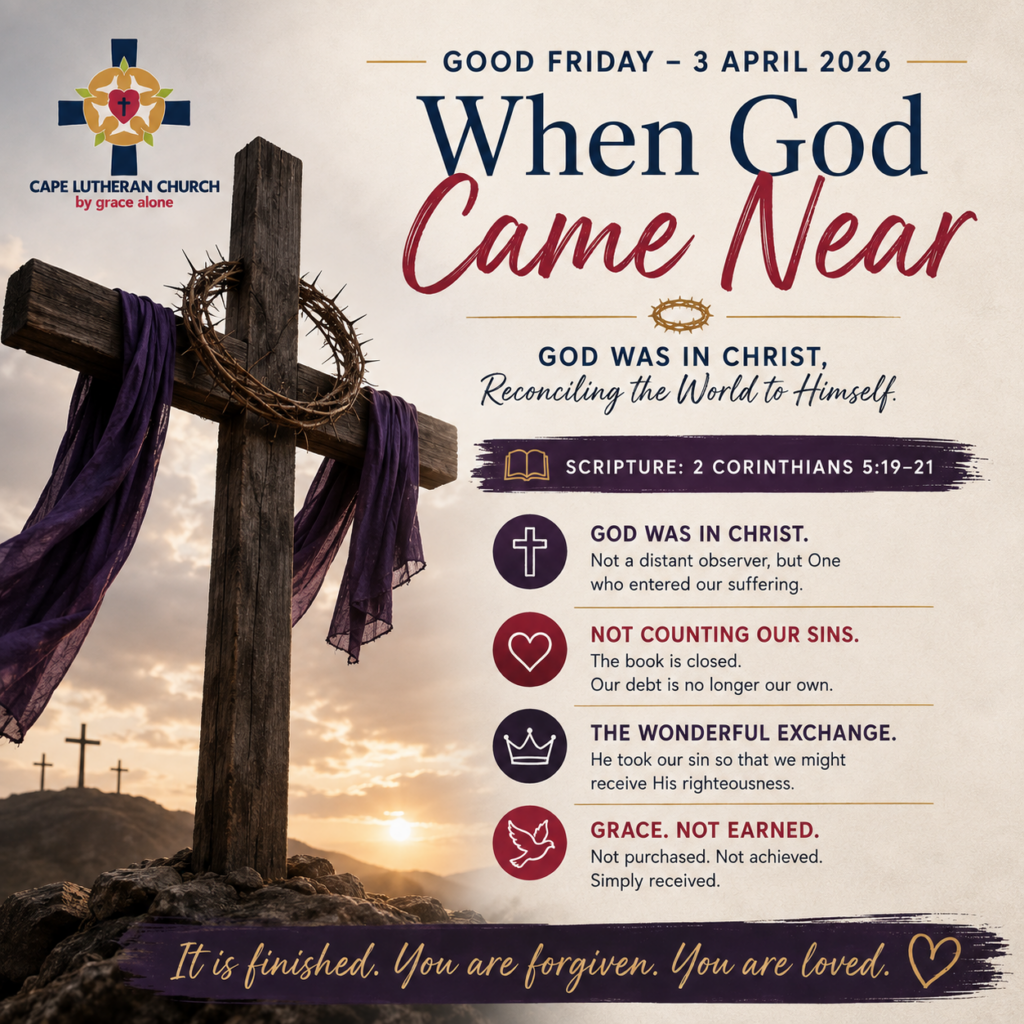
When God Came Near
God Was in Christ, Reconciling the World to Himself
Scripture: 2 Corinthians 5:19–21
There are few days in the Christian calendar as solemn as Good Friday. We enter the sanctuary quietly. The music is restrained, the colours subdued, and the cross stands before us as a stark reminder of humanity’s darkest hour. We know the story so well that we can almost tell it from memory. Jesus is betrayed by one of His own disciples, abandoned by His closest friends, condemned by religious leaders, mocked by soldiers, sentenced by a governor who knows He is innocent, and finally nailed to a Roman cross outside the city walls of Jerusalem.
It is a story we have heard countless times. Yet familiarity can sometimes prevent us from hearing its astonishing claim. Good Friday is not simply the remembrance of an execution that took place two thousand years ago. It is the revelation of the very heart of God.
Paul captures the mystery of this day in one remarkable sentence: “God was in Christ, reconciling the world to himself, not counting people’s sins against them.” (2 Corinthians 5:19)
Those words deserve to be read slowly. They tell us not only what happened on Calvary, but who God is. If someone were to ask what the cross reveals about God, Paul’s answer would be beautifully simple: God Himself was there.
This may seem obvious to Christians, but it is one of the most extraordinary claims ever made. Throughout history people have asked the same question whenever suffering enters their lives: Where is God? Where is God when war tears nations apart? Where is God when a family gathers around a hospital bed? Where is God when relationships collapse, when injustice triumphs, or when grief settles into a human heart like a permanent winter?
Good Friday does not answer those questions with a philosophical argument. It answers them with a person.
God was in Christ.
The God whom we worship is not a distant observer, watching the suffering of the world from the safety of heaven. He does not stand apart from human pain, offering explanations from afar. In Jesus Christ, God enters our brokenness completely. He knows what it means to be betrayed by a friend, misunderstood by His own people, falsely accused, abandoned, humiliated, and condemned. The cross tells us that God has chosen not merely to witness human suffering but to bear it Himself.
This is why Christians have always found hope in the crucified Christ. We do not follow a God who remains untouched by the wounds of the world. We follow the One whose hands still bear the marks of the nails. Whenever we wonder whether God understands our pain, we need only look to Calvary. There we discover that He has already walked the road we are travelling.
Yet Good Friday speaks not only about God’s presence in suffering. Paul goes on to make another astonishing declaration: God was not counting people’s sins against them.
We live in a world that keeps careful records. Every mistake is remembered, every offence replayed, every failure stored away somewhere. Nations remember old wars. Families remember old arguments. Individuals carry memories of words spoken decades earlier. We become experts at keeping score.
Many people quietly imagine that God does the same. They picture heaven as a great courtroom where an enormous ledger records every careless word, every hidden thought, every selfish action. One day, they imagine, the book will be opened and every page examined.
But Paul describes something entirely different.
The expression “not counting” comes from the language of accounting. It refers to a debt that is no longer entered into the ledger. It is no longer charged to someone’s account.
The cross announces that God has closed the book.
This does not mean that sin is unimportant. On the contrary, Good Friday reveals how devastating sin truly is. It wounds relationships, destroys communities, distorts creation, and ultimately leads to death. Sin matters so profoundly that God refuses simply to overlook it. Instead, He bears its full weight Himself. The cross is not evidence that God ignores evil; it is evidence that He confronts evil through self-giving love.
Perhaps this is one of the greatest misunderstandings about the Christian faith. Some imagine that forgiveness is merely God pretending nothing happened. But forgiveness is never forgetfulness. Forgiveness is costly. It always requires someone to carry the burden of what has been done. On Good Friday, that burden is carried by Christ.
Paul reaches the summit of the Gospel in the next verse: “God made him who had no sin to be sin for us, so that in him we might become the righteousness of God.”
Martin Luther loved this verse. He called it the wonderful exchange—the joyful exchange at the very heart of the Gospel.
● Christ takes what belongs to us so that we may receive what belongs to Him.
● He takes our guilt and gives us His righteousness.
● He takes our shame and gives us His honour.
● He takes our death and gives us His life.
● He takes our alienation and gives us reconciliation.
No human philosophy could have imagined such a God. Every religion, in one way or another, describes humanity’s attempt to climb towards God. The Gospel tells the opposite story. God comes down to us.
Imagine standing before the King clothed in garments stained by failure, regret and shame. You have nothing to offer, nothing with which to bargain, and no excuse left to make. Then Christ quietly removes His own royal robe and places it upon your shoulders. He takes your rags upon Himself, not because you deserve such mercy, but because love is the very nature of God.
● This is grace.
● Not earned.
● Not purchased.
● Not achieved.
● Simply received.
Good Friday reminds us that our salvation begins, continues and ends with God’s initiative. Before we ever sought Him, He sought us. Before we ever spoke of reconciliation, He was already reconciling the world to Himself.
Notice that Paul does not say God was reconciling only the righteous, or the faithful, or those who deserved another chance. He says that God was reconciling the world. Those two words are breathtaking in their scope. They include a world fractured by violence, scarred by injustice and divided by hatred. They include those who rejected Christ as well as those who loved Him. They include people whose lives appear beyond repair.
That truth is no less important today than it was when Paul first wrote these words.
We live in a world that often seems to be coming apart at the seams. Wars continue to displace millions. Political divisions deepen. Distrust grows between nations and neighbours alike. Even within families, reconciliation often feels painfully elusive. Many people wonder whether our world has forgotten how to forgive.
Into such a world the cross still speaks.
It reminds us that reconciliation does not begin with governments, diplomacy or human achievement. It begins with God. Long before humanity imagined the possibility of peace, God had already acted. On a hill outside Jerusalem, while hatred was doing its worst, divine love was quietly accomplishing its greatest work.
That does not mean that every conflict immediately disappears or that every broken relationship is instantly restored. We still live in a world marked by grief and loss. Good Friday is painfully honest about that reality. It does not deny suffering; it enters it. It does not ignore evil; it exposes it. Yet neither does it surrender to despair. The cross declares that evil, sin and death do not have the final word because God’s reconciling love is stronger than them all.
Perhaps this is why Christians have continued to call this day Good for centuries.
At first glance, the name seems almost contradictory. There is nothing good about betrayal, injustice, torture or death. If we were standing outside Jerusalem on that first Friday, we would almost certainly have called it the darkest day in history.
And yet, from God’s perspective, something extraordinary was taking place.
● On this day, God refused to abandon the world He had created.
● On this day, divine mercy met human sin.
● On this day, forgiveness overcame condemnation.
● On this day, love proved stronger than hatred.
Only Easter morning would reveal the full victory of the cross, but Good Friday was already the decisive turning point. The world would never be the same again.
As we stand beneath the cross once more, we discover that it still speaks with remarkable clarity.
● It tells every weary sinner that guilt need not have the final word.
● It tells every grieving heart that God is never absent from suffering.
● It tells every fractured family that reconciliation remains possible because God Himself is the author of reconciliation.
● It tells a divided world that peace begins not with us but with the God who came near.
Most of all, it tells us who God is.
● He is not the God who stands at a distance.
● He is the God who enters our pain.
● He is not the God who keeps an account of every failure.
● He is the God who bears our failures Himself.
● He is not the God who abandons His creation.
● He is the God who reconciles the world He loves.
That is why we dare to call this day Good Friday.
Not because the suffering was good.
Not because death was good.
But because, through the suffering and death of His Son, God accomplished the most hopeful act in human history. He came near to those who had wandered far from Him. He closed the ledger of sin. He opened the way to reconciliation. He embraced the world with a love that refused to let it go.
As we leave the shadow of the cross today, we do so not with easy answers, but with deep assurance. The God revealed on Calvary is the same God who walks with us still. Whatever burdens we carry, whatever griefs we bear, whatever failures weigh upon our hearts, we know this: God has not abandoned us.
He has come near.
And because He has come near, we may live in the hope that nothing—not even death itself—will ever separate us from His reconciling love.
Amen.